
Last updated October 16, 2026
 Wrought iron
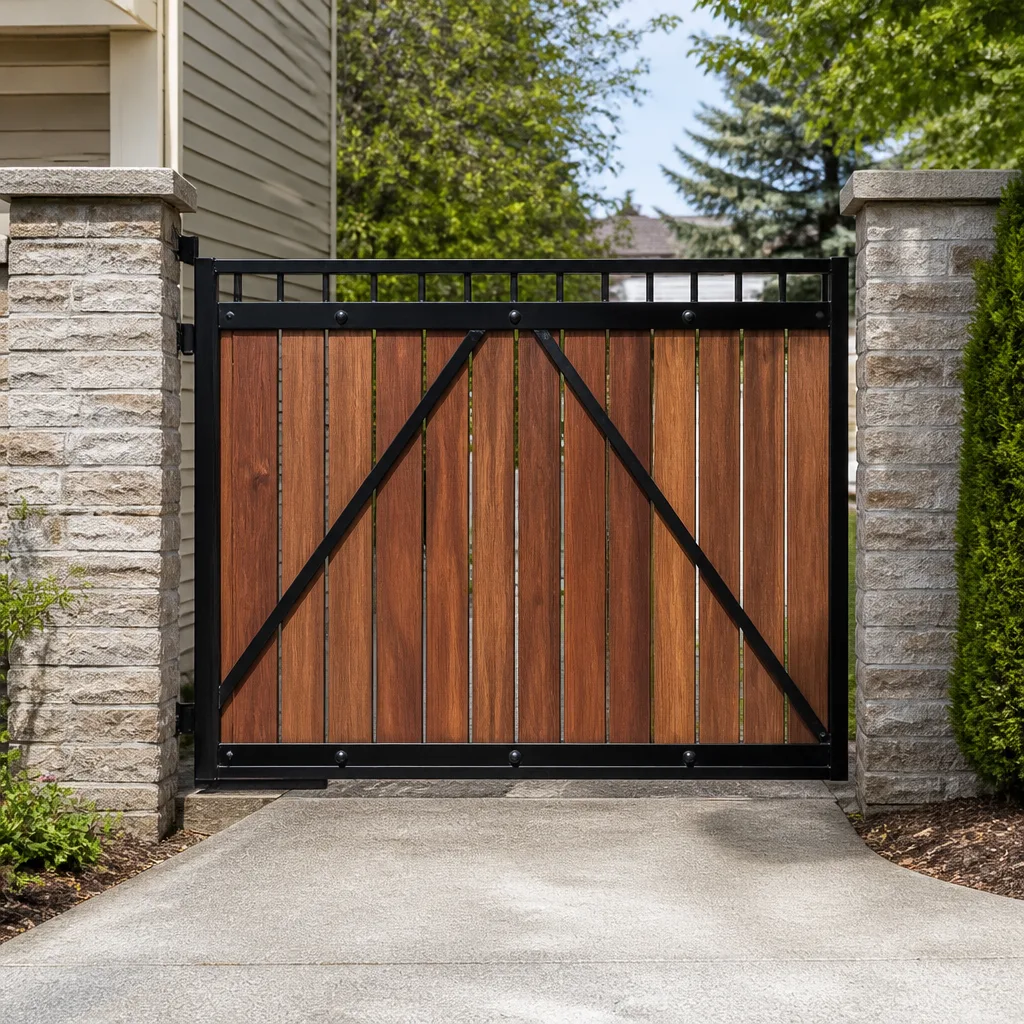 Wood & steel frame
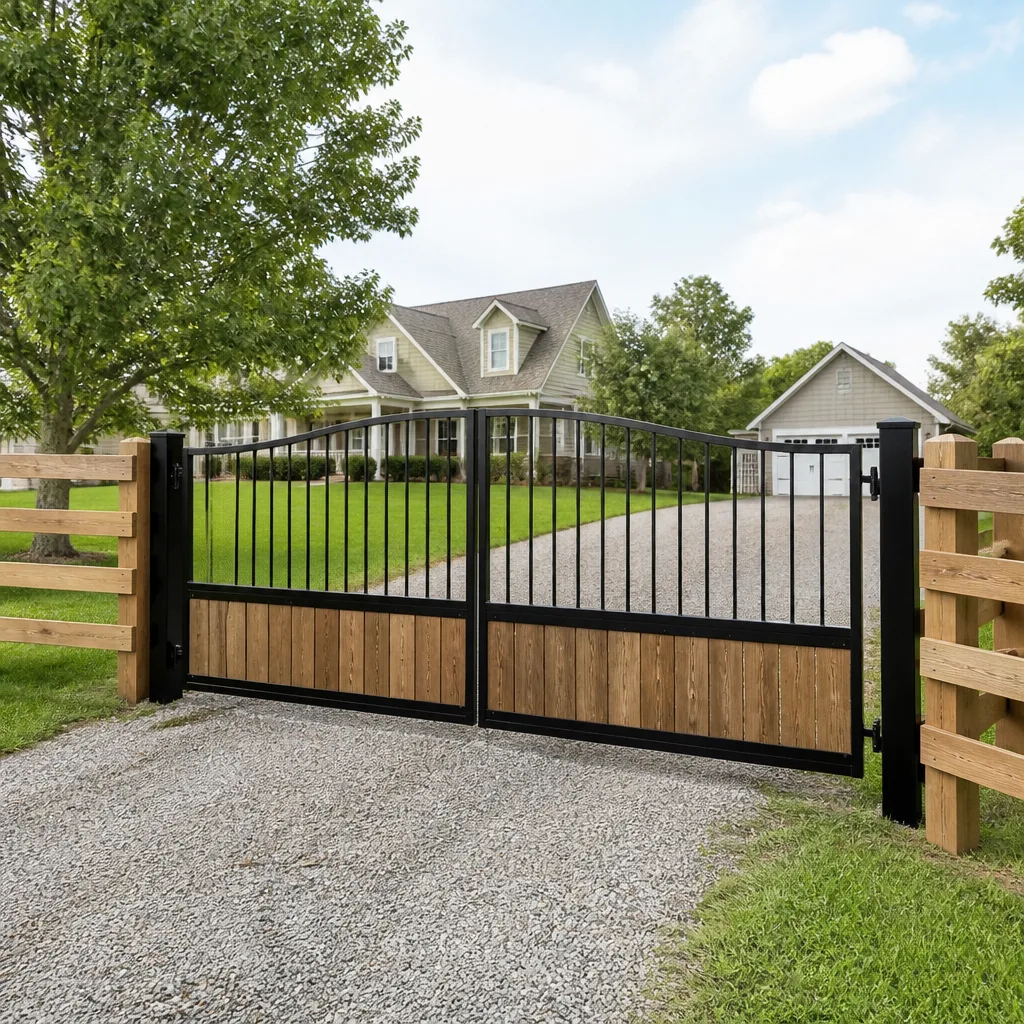 Farm & ranch
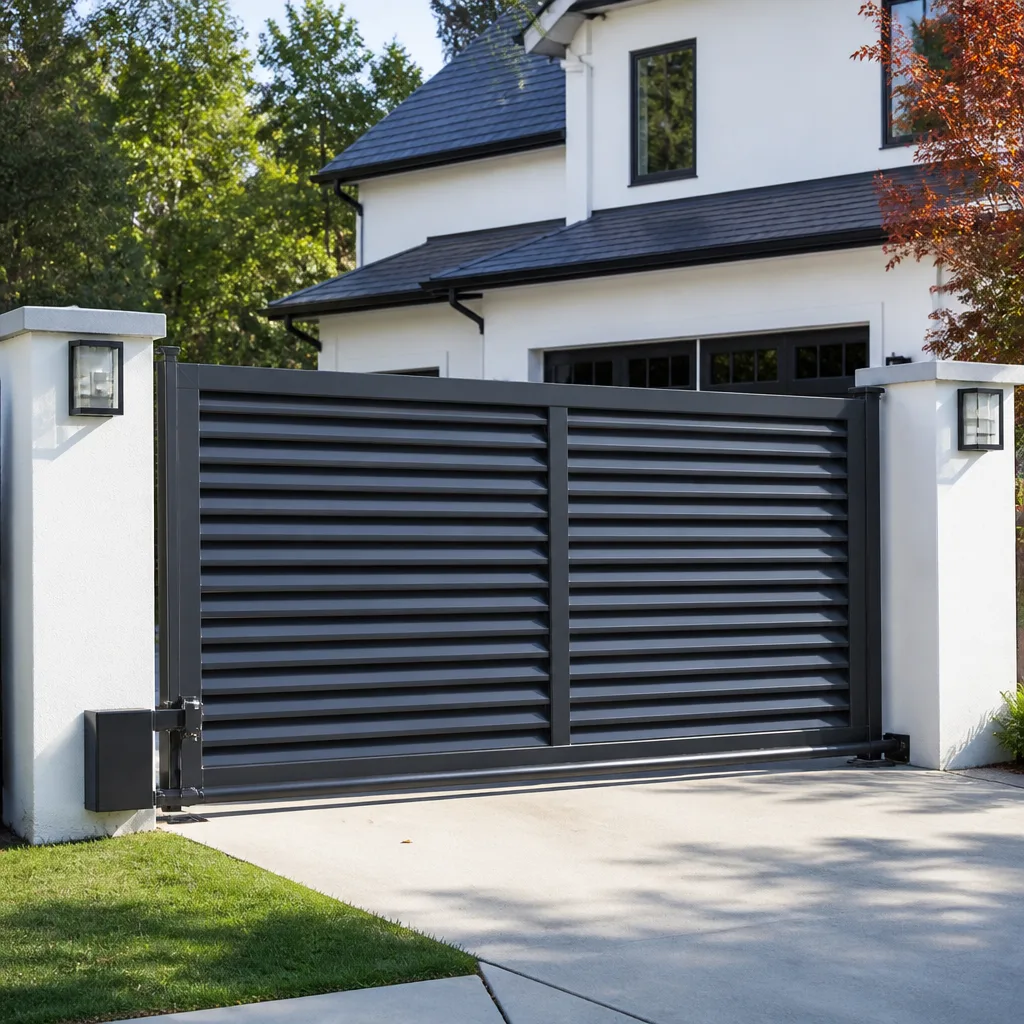 Sliding driveway gates
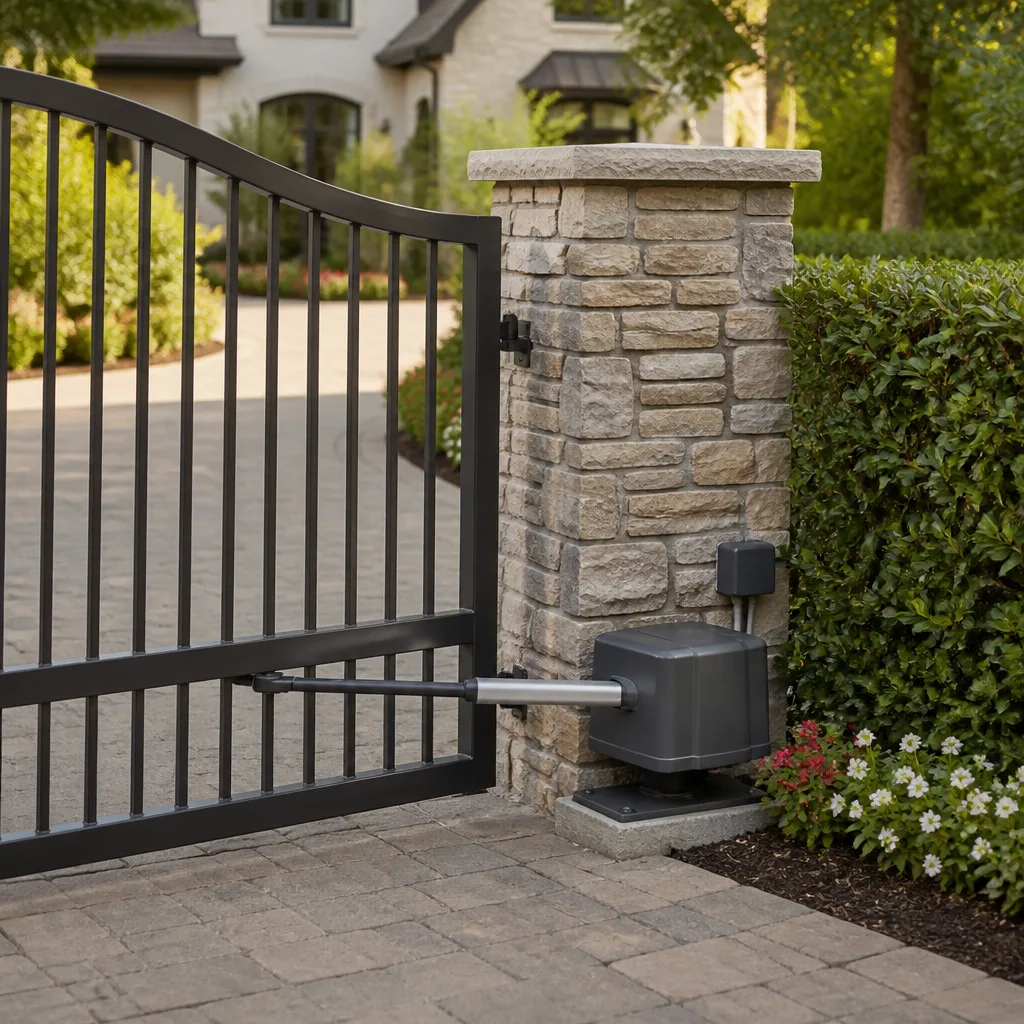 LiftMaster operators
Free on-site gate assessment - hinges, posts, and your LiftMaster or Nice gate operator checked before anything is quoted
The assessment is free and the quote is the invoice.
Get your free estimateDIY vs Professional Gate Repair: The Las Vegas Homeowner’s Decision Guide
A gate hinge replacement is one of the few home repairs where a Saturday afternoon and a socket wrench genuinely save you $150. A gate motor adjustment is another story entirely. That one screw, the one that changes how hard your gate pushes before it reverses, is governed by UL 325, the federal safety standard that exists because gates have killed people. In Las Vegas, where a gate can weigh 800 pounds and cycle 40 times a day in 110-degree heat, the line between a sensible DIY job and a liability you carry for years is sharper than most homeowners realize. This guide draws that line exactly, so you know which side of it you’re standing on before you pick up a tool.
Quick Answer
Most Las Vegas homeowners can safely handle cosmetic and non-mechanical gate repairs themselves: hinge lubrication, bolt tightening, sensor cleaning, minor rust treatment, and cosmetic touch-ups. Anything involving the gate motor, the safety sensors (photo eyes), the safety loops in the driveway, the tension on a sliding gate’s drive chain, or the structural integrity of a welded steel frame should go to a professional, because those components are regulated by Nevada contractor law and UL 325 safety standards. The split is roughly 20% DIY-appropriate work you can do with household tools, and 80% professional work where a mistake costs more than the original repair.
Styles & brands we work with
Table of Contents
- The Legal Boundary: What Nevada Law Says You Can Touch
- The DIY-Safe List: Repairs That Make Sense for a Weekend
- The Three DIY Repairs Las Vegas Homeowners Botch Most
- The Real Cost Comparison: DIY vs Professional in Las Vegas
- Why Las Vegas Heat Punishes DIY Repairs Differently
- The Four-Question Decision Framework
- Common Mistakes to Avoid
- When to Call a Professional
- Frequently Asked Questions
The Legal Boundary: What Nevada Law Says You Can Touch
Nevada draws a hard line through the middle of gate repair, and it’s printed in NRS 624, the state’s contractor licensing statute. You don’t need a contractor’s license to work on your own home. But the work you do yourself has to stay on the cosmetic and non-mechanical side of that line, because the moment a repair touches automated safety systems, you’re not just fixing a gate anymore. You’re maintaining a device that state and federal regulators treat as a potential injury source, and the liability follows the person who adjusted it last.
Here’s the boundary in plain terms:
Work a Las Vegas homeowner can legally and practically do without a contractor’s license:
- Tightening or replacing hinge bolts, bracket bolts, and fasteners on a manual or automatic gate, as long as the gate itself is not being re-hung or structurally altered
- Lubricating hinges, rollers, and the gate track with a dry silicone or lithium-based lubricant
- Cleaning photo eye sensors with a soft, dry cloth to remove dust, spider webs, and monsoon-season debris
- Repainting or touching up rust spots on the gate surface, as long as the rust has not compromised the structural steel
- Trimming vegetation away from the gate path, the track, the safety loops, and the sensor line of sight
- Replacing non-electric hardware like a gate latch, a pull handle, or a gate stop, provided no welding is required
Work that requires a licensed contractor in Nevada:
- Any repair, adjustment, or replacement of the gate motor, including limit switches, force settings, and internal gears
- Any work on the safety sensors: photo eyes, safety loops cut into the driveway, contact edges, or the wiring that connects them
- Any re-welding of a gate frame, hinge post, or structural member, especially on a cantilever or slide gate
- Re-hanging a gate that has come off its hinges or jumped its track in a way that changes the gate’s weight distribution or travel path
- Installing, moving, or re-wiring any low-voltage or line-voltage electrical supply to the gate
- Any modification to the gate’s speed, force, or reversal settings governed by UL 325
The UL 325 standard isn’t a suggestion. It’s a federal safety standard the Consumer Product Safety Commission enforces. If a gate closes on a person or a vehicle because someone adjusted the force setting too high, the person who turned that screw owns the liability. Homeowners insurance policies generally exclude damage caused by unlicensed work on regulated equipment, which means the repair itself becomes the thing that voids your coverage. In Las Vegas, where gates open onto streets with pedestrian traffic and school walking routes, that’s not an abstract risk. It’s a real one with a name attached to it.
For the non-structural, non-mechanical items on the DIY-safe list, a competent homeowner with basic tools can do solid work. Warden Gate Repair has watched enough Las Vegas homeowners succeed at these tasks that we’ll tell you exactly how to do them right in the next section. But when a gate motor starts making a grinding noise, or a safety loop stops detecting a car in the driveway, the legal and practical answer is the same: that’s professional Gate Repair in Las Vegas, and it’s not worth the liability to guess.
The DIY-Safe List: Repairs That Make Sense for a Weekend
Twenty percent of gate problems don’t require a service call at all. They require a can of lubricant, a set of wrenches, and about two hours on a Saturday morning. Knowing which problems land in this category saves real money, and doing these tasks correctly makes the professional service you eventually need simpler and cheaper.
Here’s what we tell Las Vegas homeowners they can confidently handle themselves, with the exact method for each:
1. Hinge lubrication on a swing gate
Las Vegas dust is finer than flour and it works its way into every hinge pivot within a season. A dry, squealing hinge is the most common gate complaint we hear that doesn’t need us. Use a dry silicone spray or a white lithium grease, apply it to the hinge pin and the hinge barrel, and swing the gate through its full travel six or eight times to work the lubricant in. Do this every three months in Las Vegas, and you’ll double the life of your hinge bushings. If the hinge is visibly sagging, cracked, or the gate leaf has dropped more than half an inch, stop lubricating and start planning a replacement. Lubricant doesn’t fix a hinge that’s carrying more weight than it was sized for.
2. Photo eye cleaning
The small plastic sensors on either side of your gate opening, usually mounted on posts about a foot off the ground, get covered in dust, spider webs, and monsoon rain spots within weeks in Las Vegas. When they’re dirty, the gate thinks something is in the way and refuses to close, which homeowners often misread as a motor problem. Wipe both lenses with a dry microfiber cloth. Don’t use glass cleaner, which can leave a film that attracts dust faster. If the gate still won’t close after both lenses are clean, look for the small LED indicator light on each sensor. If one isn’t lit, or if it’s blinking a specific number of times, that’s a fault code, and the fix belongs to a professional.
3. Fastener tightening on the gate frame and hinges
Automatic gates cycle thousands of times a year in Las Vegas, and the constant motion works bolts loose. Once a year, take a socket set and check every visible bolt on the gate frame, the hinge brackets, and the mounting posts. Tighten any that have backed off. If you find a bolt that spins without ever getting tight, the threaded hole is stripped and needs to be re-tapped or replaced. Do not use a longer bolt as a workaround; it creates a false tightness that fails without warning.
4. Track cleaning on a sliding gate
Sliding gates run on a steel track at ground level, and that track collects rocks, sand, and plant debris constantly in the Las Vegas desert. A piece of gravel in the track can cause the gate to bind mid-travel, which puts extra load on the motor and trips the safety reversal. Sweep the track clear with a stiff brush, then check the gate’s travel by hand with the motor disengaged (most motors have a manual release, usually a red knob or pull chain). If the gate rolls freely by hand, the track is fine. If it binds or wobbles, the gate wheels or guide rollers are worn and need professional replacement.
5. Cosmetic rust treatment and repainting
Las Vegas is dry, but the monsoon months and irrigation overspray create micro-climates of moisture on low gate sections. Surface rust on gate panels, posts, and horizontal rails is treatable by a homeowner with a wire brush, a rust-converting primer, and an exterior-grade enamel. Wire-brush the loose rust off, apply one coat of rust converter, then topcoat within 24 hours. This is a weekend job worth doing before the rust reaches the point where the metal holds less weight than it did when it was installed. If you can see daylight through a rusted section, or if the steel deflects when you push on it, the panel has lost structural integrity and needs professional replacement, not paint.
These five tasks represent the realistic DIY boundary for gate work in Las Vegas. They’re all mechanical in the sense of bolts and lubrication, but none of them touch the motor, the safety system, the wiring, or the structural steel. That’s the line, and it’s where the next section begins.
The Three DIY Repairs Las Vegas Homeowners Botch Most
In our experience at Warden Gate Repair, there are three gate repairs that homeowners attempt with confidence and regret with regularity-situations where calling our Gate Repair services from the start would have saved far more. Each one starts from a reasonable desire to save money. Each one ends with a failure mode that’s worse than the original problem. Here’s what these three repairs are, what goes wrong, and what the corrective professional repair costs after the fact.
1. Adjusting the motor’s force or sensitivity setting
The symptom is usually simple: the gate stops halfway, or reverses at the smallest touch, or doesn’t seem to close all the way. The homeowner opens the motor cover, finds the small adjustment screw or digital interface labeled “force” or “sensitivity,” and turns it up a quarter turn. The gate closes. The problem seems solved.
Here’s what actually happened. UL 325 requires that an automatic gate reverse within two seconds of encountering an obstruction, and that the amount of force it exerts on that obstruction stays below a specific threshold. When you increase the force setting, you’re telling the gate to push harder before it gives up and reverses. The gate now closes when it couldn’t before, but it also now has enough force to injure a child, a pet, or an adult who happens to be in its path. The failure mode on this DIY repair isn’t a broken gate. It’s a gate that works and is now dangerous, which is the worst possible outcome because it gives false confidence while creating real liability. We’ve been called to homes in Summerlin and Henderson where a homeowner had been running an over-force gate for six months before a neighbor complained that their car door got dented. The professional correction requires resetting the force to UL 325 compliance and usually replacing an entrapment sensor that the over-force setting damaged.
2. Re-welding a cracked gate hinge or frame member
A crack in a gate frame looks like a straightforward welding job, and many Las Vegas homeowners own or know someone with a flux-core welder. The reasoning goes: the gate is steel, the crack is steel, weld the crack and the gate is fixed. The problem is that gate steel in Las Vegas lives in an environment where the ambient temperature swings from 40 degrees on a January night to 115 degrees on a July afternoon, and a bad weld creates a stress concentration that fails in months, not years. The original weld on a quality gate was done in a controlled shop environment with proper joint preparation, and the gate was designed so that weld sits in a low-stress location. A homeowner with a flux-core welder working in a driveway, without pre-heating or post-weld cooling control, deposits a weld that’s harder and more brittle than the surrounding steel. That brittle weld cracks along its edge within a season. Worse, if the cracked component was a hinge bracket or a cantilever support, the second failure is often more destructive than the first, because the gate is now heavier, the crack traveled further, and the repair area is contaminated with flux and porosity that a professional repair has to grind out before re-welding. The professional repair after a botched homeowner weld typically costs more than the original professional weld would have, because the bad weld has to be removed first.
3. “Testing” or rewiring a safety loop after a false detection problem
Safety loops are the wire loops cut into the driveway in a saw-cut channel, sealed with sealant, and connected to a loop detector box in the motor housing. When a loop stops working, the gate often refuses to close, because the logic board doesn’t know whether a car is sitting in the gate path. A homeowner’s first instinct is to access the detector box and either bypass the loop with a jumper wire or splice the loop wire where it comes up out of the ground. Both moves are bad. Bypassing the loop tells the gate to ignore the driveway entirely, which converts a safety device into decorative wire. Splicing a broken loop wire without the correct waterproofing and resistance matching creates an intermittent connection that works on cool mornings and fails on hot afternoons, so the homeowner chases the same problem for weeks. The correct repair requires a loop detector diagnostic to determine whether the loop itself has failed underground or the detector box is bad, and a failed loop often means cutting a new saw joint and laying a new loop, which requires a concrete saw and specific sealing materials. This is not a residential DIY repair under any circumstances. The professional corrective cost on a botched loop repair often includes replacing the detector box that the homeowner shorted out, doubling the price of what would have been a routine loop replacement.
The common thread in all three of these is that the DIY attempt doesn’t fail immediately. It fails in a way that creates either a safety risk that persists for months or a secondary damage that’s more expensive to fix than the original problem. If you’re looking at one of these three repairs, the Electric Gate Repair in Las Vegas route is the one that keeps the final cost lower than the DIY attempt will.
The Real Cost Comparison: DIY vs Professional in Las Vegas
Cost is the reason homeowners attempt DIY gate repair, so let’s look at the real numbers for Las Vegas, not hypothetical numbers. For deeper context, see our Gate Repair Cost Breakdown: The Las Vegas Homeowner’s Reference for 2026. These ranges reflect what the major gate and opener brands actually cost in the Las Vegas market in 2025, what parts and materials run at local supply houses and online, and what a professional repair actually bills when it’s done right the first time.
Scenario 1: Hinge replacement on a steel swing gate
| Item | DIY Cost | Professional Cost |
|---|---|---|
| Parts (pair of heavy-duty hinges) | $40 – $90 | Included in job price |
| Tools (socket set, drill, level) | $0 – $80 if you own tools | Included |
| Labor and expertise | Your time (3 – 5 hours) | $180 – $350 total job |
| Warranty | None | Written, typically 1 year |
| Actual out-of-pocket | $40 – $170 | $180 – $350 |
Hinge replacement is genuinely DIY-viable, and the savings are real. The catch is that if the gate is off-level after you hang it, the motor has to work against gravity, and a motor that works against gravity fails sooner. A professional installation includes leveling the gate so the motor loads correctly, which is the long-term protection you’re really buying.
Scenario 2: Gate motor capacitor replacement
| Item | DIY Cost | Professional Cost |
|---|---|---|
| Capacitor part | $12 – $35 | Included |
| Diagnostic time (multimeter, wiring trace) | 2 – 4 hours of trial and error | Included in service call |
| Risk of wrong diagnosis | High; you buy the part and the motor still doesn’t run | None; diagnosis confirmed before replacement |
| Labor | Your time | $120 – $250 total job |
| Actual out-of-pocket | $12 – $35 if diagnosed correctly; $50 – $150+ if misdiagnosed | $120 – $250 |
Capacitor replacement is the trap repair. The part is cheap, the YouTube video makes it look easy, and the diagnosis is where the real skill lives. A clicking motor that won’t start can be a bad capacitor, a stuck limit switch, a relay on the logic board, or a seized gearbox. Guess wrong, and you’ve spent the weekend and $35 and the gate still doesn’t work. A professional diagnostic run with a meter takes 20 minutes and confirms the exact fault before any parts go in.
Scenario 3: Full gate motor replacement (the big one)
| Item | DIY Cost | Professional Cost |
|---|---|---|
| New gate motor (varies by brand and capacity) | $400 – $1,200 | $400 – $1,200 at actual cost |
| Mounting hardware, wire, connectors, conduit | $50 – $150 | Included |
| Permit and inspection (where required) | $75 – $250 | Handled by professional |
| Labor and programming | Your time (1 – 2 full weekends) | $400 – $800 |
| Safety sensor replacement and UL 325 compliance | Often skipped by DIYers | Included |
| Warranty | Manufacturer only, often voided by self-install | Manufacturer + workmanship |
| Actual out-of-pocket | $525 – $1,600 plus possible insurance voidance | $800 – $2,000 with full warranty and compliance |
The DIY motor replacement math looks attractive until you factor in the warranty. Major gate motor manufacturers, including Linear, Viking, Ghost Controls, and DoorKing, write their warranties with professional installation as a condition. A homeowner-installed motor that fails in month three has no warranty protection, and the manufacturer will tell you exactly that on the phone. The professional route costs more up front and protects the investment for years, which is why Warden Gate Repair’s Gate Motor Repair in Las Vegas service always includes the warranty documentation with every install.
Why Las Vegas Heat Punishes DIY Repairs Differently
The Las Vegas climate is the least forgiving environment in the continental United States for gate hardware. A repair that would last five years in Phoenix or a decade in San Diego often fails in two years in Las Vegas if the environmental factors weren’t accounted for, and DIY repairs, by definition, rarely account for them.
The specific Las Vegas challenges are:
- Thermal expansion on steel gates. A 20-foot steel gate that’s 80 degrees at dawn is 140 degrees by mid-afternoon in July. That’s a linear expansion of about 0.08 inches per 100 degrees F per 10 feet, which means the gate grows more than a quarter inch over a single day. A DIY repair that doesn’t leave the correct gap between the gate and the latch post will bind at 3 p.m. in July and work fine every other hour of the year. Professional installers in Las Vegas account for this with expansion gaps, and the measurement is part of the job.
- UV degradation on plastic and rubber components. The photo eye housings, the motor cover, the wire insulation, and the plastic gear components inside many modern operators all degrade faster under Las Vegas’s 300+ days of full sun. A DIY repair that reuses old UV-damaged components saves money today and fails in the heat, exactly when you’ll be outside trying to fix it again.
- Cantilever gate failures from wind loading. Las Vegas experiences consistent afternoon winds in the spring, with gusts over 40 mph. A cantilever slide gate, properly installed, resists those winds with a counterweighted design and a correctly tensioned drive chain. A homeowner-repaired cantilever gate that’s slightly out of balance will oscillate in the wind and eventually snap a roller, throw the chain, or bend the drive rail. The repair job for that damage costs more than the original professional balance adjustment would have.
- Monsoon season and electrical corrosion. The Las Vegas monsoon brings sudden, violent rainstorms in July and August. Gate wiring connections that were not properly sealed with waterproof connectors corrode within a season. DIY electrical connections made with twist-on wire nuts and electrical tape fail within weeks under these conditions. The experienced Las Vegas gate professional uses heat-shrink connectors and dielectric grease as a matter of course, because they’ve seen what the monsoon does to bare connections.
None of this is visible to the homeowner attempting a first-time repair. The hardware store clerk doesn’t mention thermal expansion gaps or cantilever balance. The YouTube tutorial was filmed in a garage in Ohio where the daily temperature swing is 20 degrees, not 60. And the result is a repair that lasts 18 months in Las Vegas where a professional repair, accounted for the environment, lasts eight years.
The Four-Question Decision Framework
Every gate repair decision in Las Vegas, from a squeaky hinge to a dead motor, routes through the same four questions. Answer them honestly, in order, and the DIY-vs-professional decision makes itself. No guesswork.
- Does the repair touch the motor, the safety sensors, the safety loops, or the wiring? If yes, stop. The answer is professional, every time, no exceptions. These components are regulated by UL 325, protected by Nevada contractor law, and failure to comply creates personal liability and insurance exclusion. This one question eliminates about 80% of gate repairs, which is exactly the percentage that belongs in professional hands.
- Does the repair require welding or structural metalwork? If yes, the answer is professional unless you are a certified welder with shop experience on structural steel. Gate frames and hinge brackets carry dynamic loads, and a bad weld fails in months in the Las Vegas climate. If the crack is in a structural member, the gate is telling you it’s carrying weight it can’t handle, and the professional question is whether to repair or replace, not whether to weld.
- Can you complete the repair within one day with tools you already own, without buying specialty equipment? If the repair requires buying anything beyond basic hand tools, the money you spend on the specialty tool is usually better spent on a professional who already owns it and knows how to use it. A $300 welder, a $150 concrete saw, or a $100 multimeter you’ll use once is a false economy when the professional service call costs less than the tool.
- If the repair fails, will the failure mode be expensive or dangerous? This is the honest reality check. If you lubricate a hinge and it still squeaks, nothing bad happens. If you adjust a motor’s force setting and the gate now pushes with enough power to hurt someone, the failure mode is dangerous and you own it. If page one of the repair involves the word “force,” “sensitivity,” “loop,” or “limit switch,” the failure mode is not worth the risk.
Run these four questions on any gate repair you’re considering. Three yes-answers in the DIY-safe direction, and you have a legitimate weekend project. One professional-flag answer, and you have a phone call to make.
Common Mistakes to Avoid
- Using WD-40 on gate hinges and rollers. WD-40 is a water displacer, not a lubricant. It penetrates and cleans, then dries out and leaves the hinge with no lasting protection. On a Las Vegas gate that needs lubrication every three months, WD-40 means you’re redoing the job every three weeks. Use a dry silicone spray or white lithium grease instead.
- Cranking up the force setting to fix a gate that reverses too easily. A gate that reverses without obstruction is usually telling you something specific: a dirty photo eye, a bad safety loop, a binding roller, or a worn gear. Turning up the force silences the symptom and creates a dangerous gate. The correct response is a diagnostic, not a force adjustment.
- Reusing old wire nuts and electrical tape on a splice. The Las Vegas monsoon finds every unsealed connection. Splices made with wire nuts and tape fail within a season and cause intermittent gate problems that are harder to diagnose than the original fault. Professional connections use heat-shrink and dielectric compound for a reason.
- Welding a gate frame crack without understanding the metallurgy. Gate steel in the Las Vegas heat needs a specific weld procedure to avoid creating a brittle zone that cracks again. Homeowner welds with flux-core wire leave flux inclusions and create hardness levels that don’t match the parent metal. The second crack is usually bigger than the first.
- Bypassing a safety photo eye or loop instead of repairing it. Bypassing a safety sensor turns a regulated safety device into a decoration. The gate works, and it’s now dangerous in the exact moment you’ve convinced yourself it’s fixed. Safety devices are not optional, and bypassing one has the same legal effect as disconnecting it.
- Buying a replacement motor online without checking brand compatibility. Gate motors from different manufacturers use different wiring protocols, different remotes, and different mounting patterns. The Linear motor that fits your old bracket won’t necessarily talk to your DoorKing keypad, and vice versa. The professional install starts with a compatibility check so you don’t end up with a $600 motor that doesn’t integrate with your existing access controls.
- Waiting until the gate fully fails before addressing a symptom. A gate that’s been slowing down, making noise, or reversing unexpectedly for a month is sending signals. In Las Vegas, where gates cycle constantly in extreme heat, a minor symptom progresses to a full failure faster than in milder climates. Addressing a symptom at the squeaky-hinge stage costs $200. Addressing it at the snapped-drive-chain stage costs $800.
When to Call a Professional
Call a professional when the repair touches the motor, a safety sensor, a safety loop, or the wiring. Call when the gate needs welding. Call when the gate has come off its track, sagged more than half an inch, or started making a noise it never made before. Call when you’ve tried the DIY-safe fix and the problem persists, because at that point the diagnosis is the work, and diagnosis is the skill. Call when the gate controls access to a community pool, a shared driveway, or a property where someone else’s child might walk through the opening, because the liability on that gate belongs to whoever touched it last.
If you’re in the Las Vegas valley, Warden Gate Repair Las Vegas offers free estimates on gate repairs in Las Vegas, Henderson, Summerlin, and surrounding communities. Every job starts with a written price before any work begins, a licensed and insured technician whose name and photo you receive before arrival, and a repair guaranteed by the 365-Day Done Right Promise. Call (725) 529-9468 and a live person answers, 24 hours a day, every day of the year.
Frequently Asked Questions
Yes, Nevada law allows homeowners to perform cosmetic and non-mechanical maintenance on their own automatic gates, including hinge lubrication, bolt tightening, photo eye cleaning, and rust treatment. Work that requires a contractor’s license under NRS 624 includes any adjustment or repair to the gate motor, safety sensors, safety loops, electrical wiring, and any structural welding, because these components are regulated by UL 325 and the state’s contractor licensing board.
Professional gate repair in Las Vegas typically ranges from $150 to $350 for minor repairs like hinge replacement, capacitor replacement, and sensor repair, and $800 to $2,000 for a full gate motor replacement with programming and warranty. The exact price depends on the brand (Linear, Viking, Ghost Controls, DoorKing, and others), the gate size and weight, and whether parts are readily available. Call (725) 529-9468 for a free estimate with a written price.
A Las Vegas homeowner can safely handle hinge lubrication with dry silicone or lithium grease, photo eye cleaning with a dry cloth, visible bolt tightening with a socket set, track sweeping on a sliding gate, and cosmetic rust treatment and repainting. These repairs don’t touch the motor, the electrical system, or the safety devices, and they don’t require welding or structural modification.
If you adjust your gate motor’s force setting and the gate later injures a person or damages property, you are personally liable for that injury or damage under UL 325 regulations, and your homeowners insurance may refuse to cover the claim because the work was performed by an unlicensed person on regulated equipment. UL 325 requires specific force limits and reversal timing on every automatic gate, and the person who last adjusted those settings is responsible for compliance.
Las Vegas heat accelerates gate repair failures because steel gates expand significantly between morning and afternoon temperatures, UV exposure degrades plastic and rubber components faster, monsoon storms cause electrical corrosion in unsealed connections, and afternoon winds stress cantilever gates and their drive chains. Repairs that don’t account for thermal expansion, UV protection, sealed electrical work, and wind loading fail in months in Las Vegas where they would last years in a milder climate.
Ask four questions: Does it touch the motor, sensors, loops, or wiring? Does it require welding? Can you complete it in one day with tools you already own? Would the failure mode be expensive or dangerous? One professional-flag answer to any of these questions means the repair belongs to a professional, because gate motors and safety systems are regulated components where a mistake creates liability and a more expensive repair down the line.
The Bottom Line
The DIY-vs-professional gate repair decision comes down to one distinction: whether the repair is mechanical and regulated or cosmetic and non-mechanical. Las Vegas homeowners can safely lubricate hinges, clean photo eyes, tighten bolts, sweep tracks, and treat surface rust. Everything else, from a capacitor to a safety loop to a force adjustment to a weld, belongs in professional hands because the liability and the failure modes are not worth the up-front savings. The Las Vegas climate punishes shortcuts faster than most, and the brands we service, including Linear, Viking, Ghost Controls, and DoorKing, carry warranties that only protect you when a licensed professional does the work. For the 80% of repairs on the professional side of the line, Warden Gate Repair Las Vegas home service area covers the entire valley, with written prices, name-and-photo technician verification, and live 24/7 phone coverage at (725) 529-9468.
Written by Cole Rafferty, Owner at Warden Gate Repair Las Vegas, serving Las Vegas since 2008.
See the difference
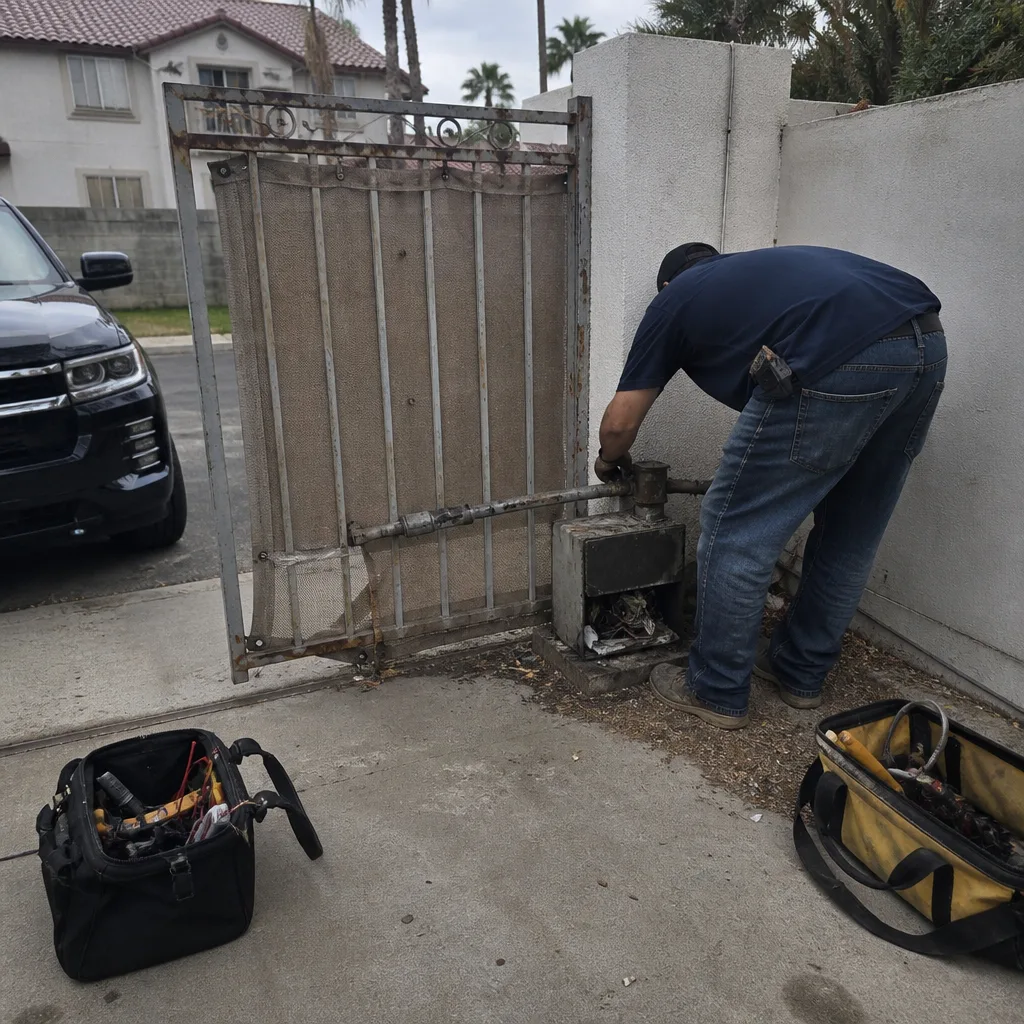 Before
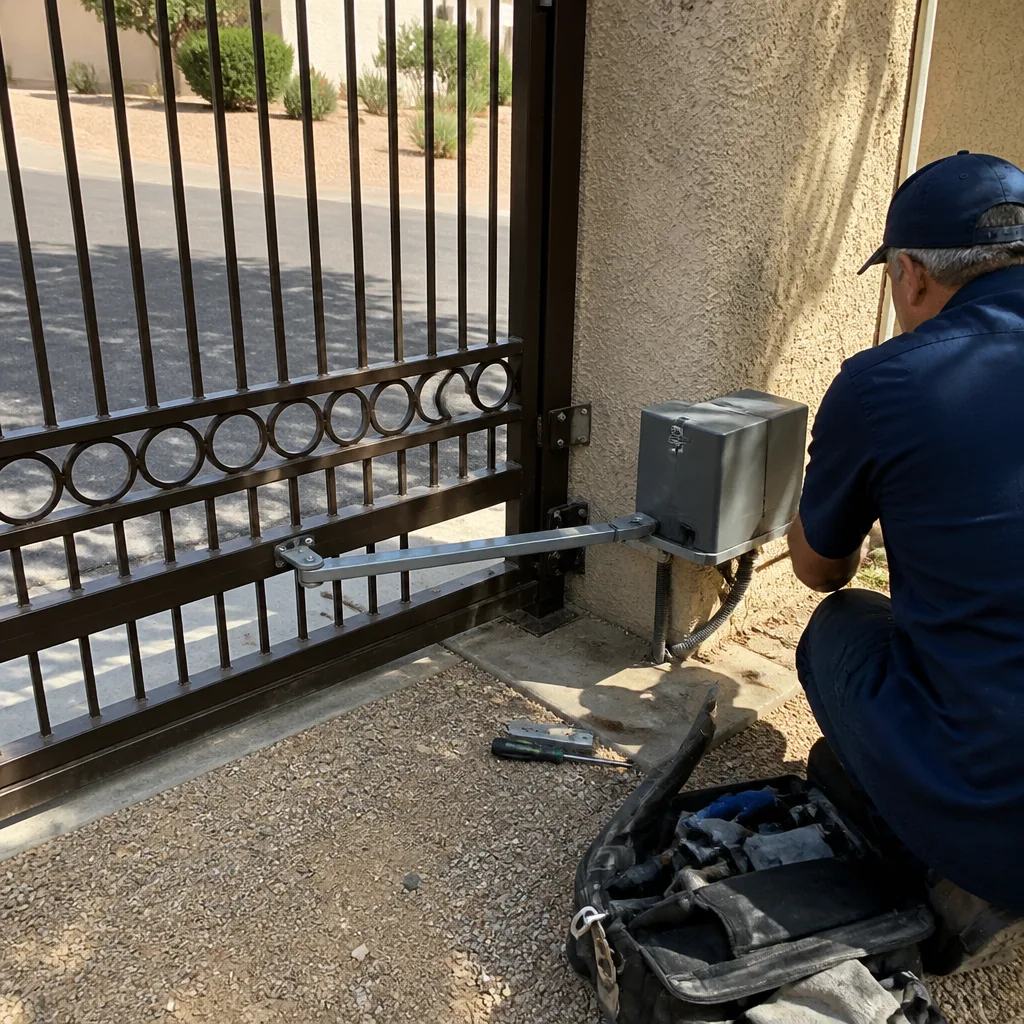
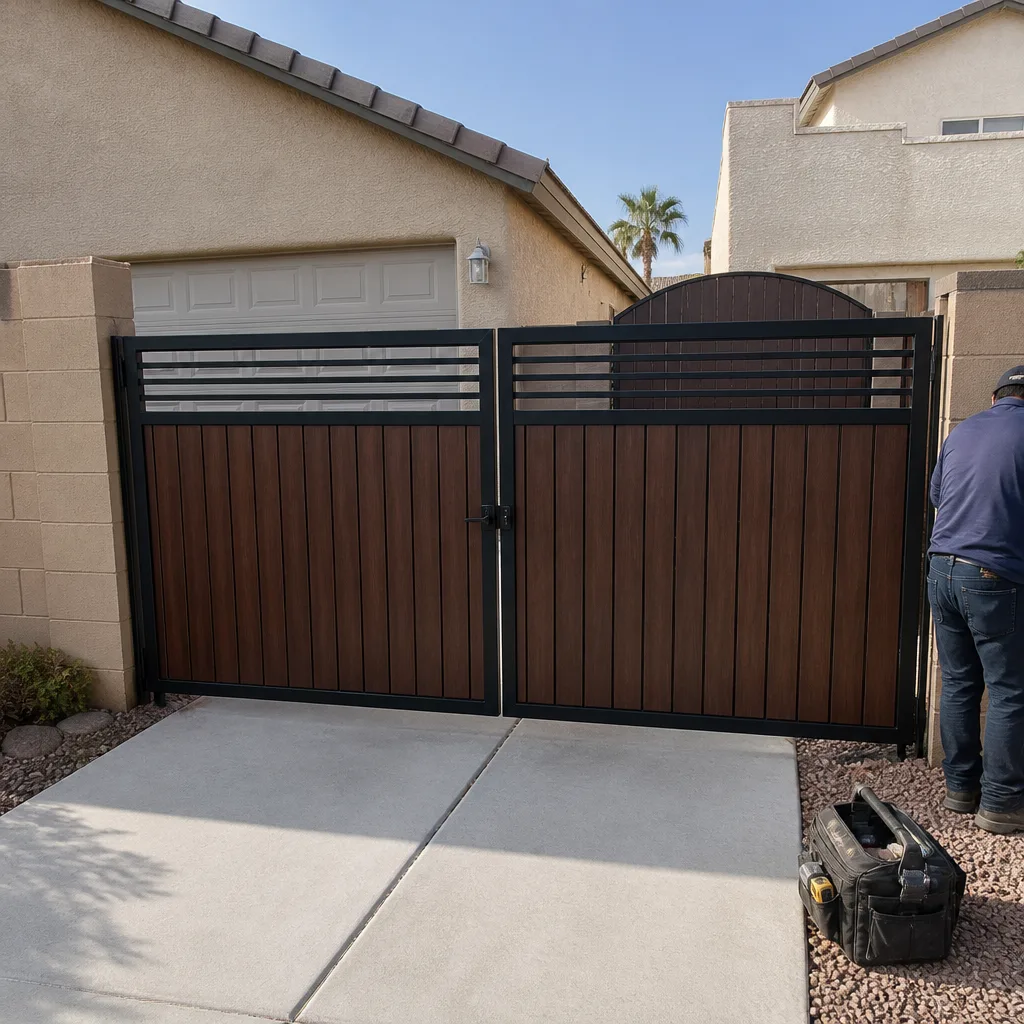 After
After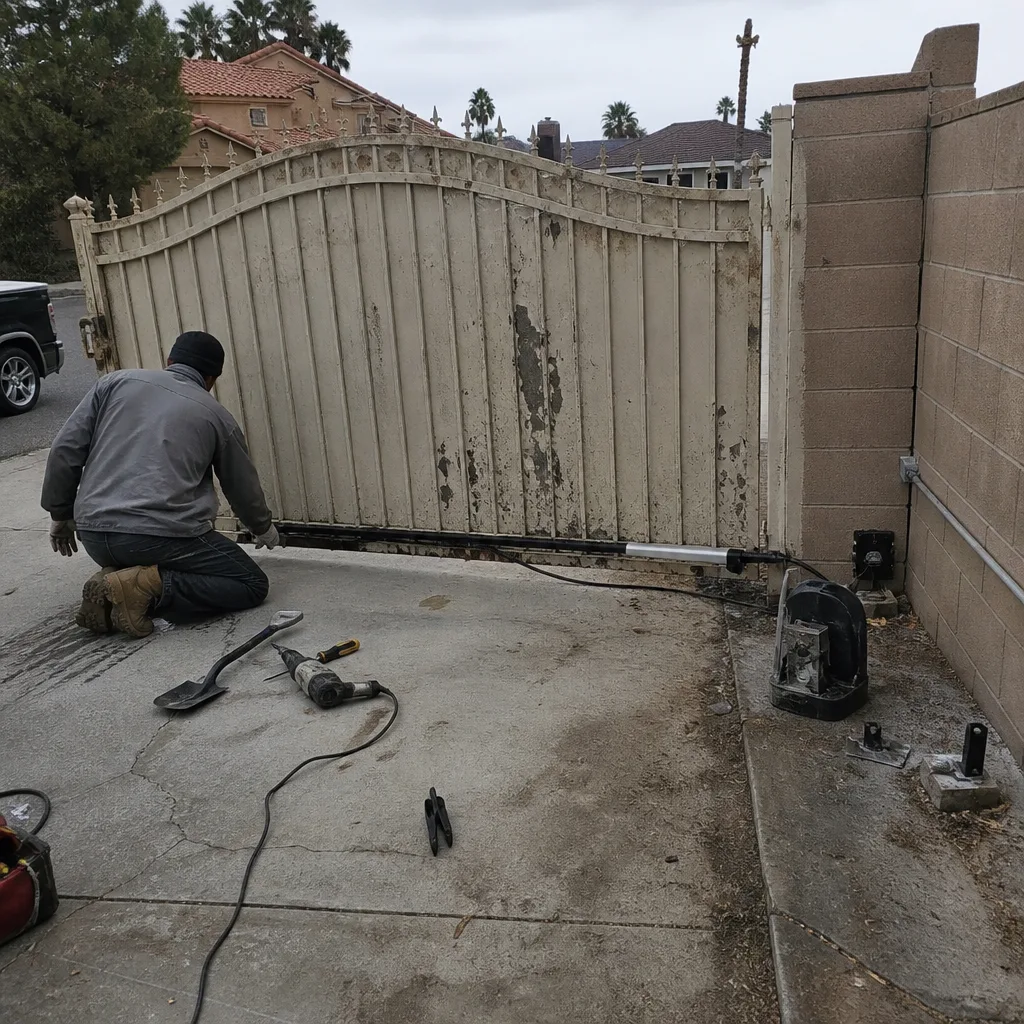 Before
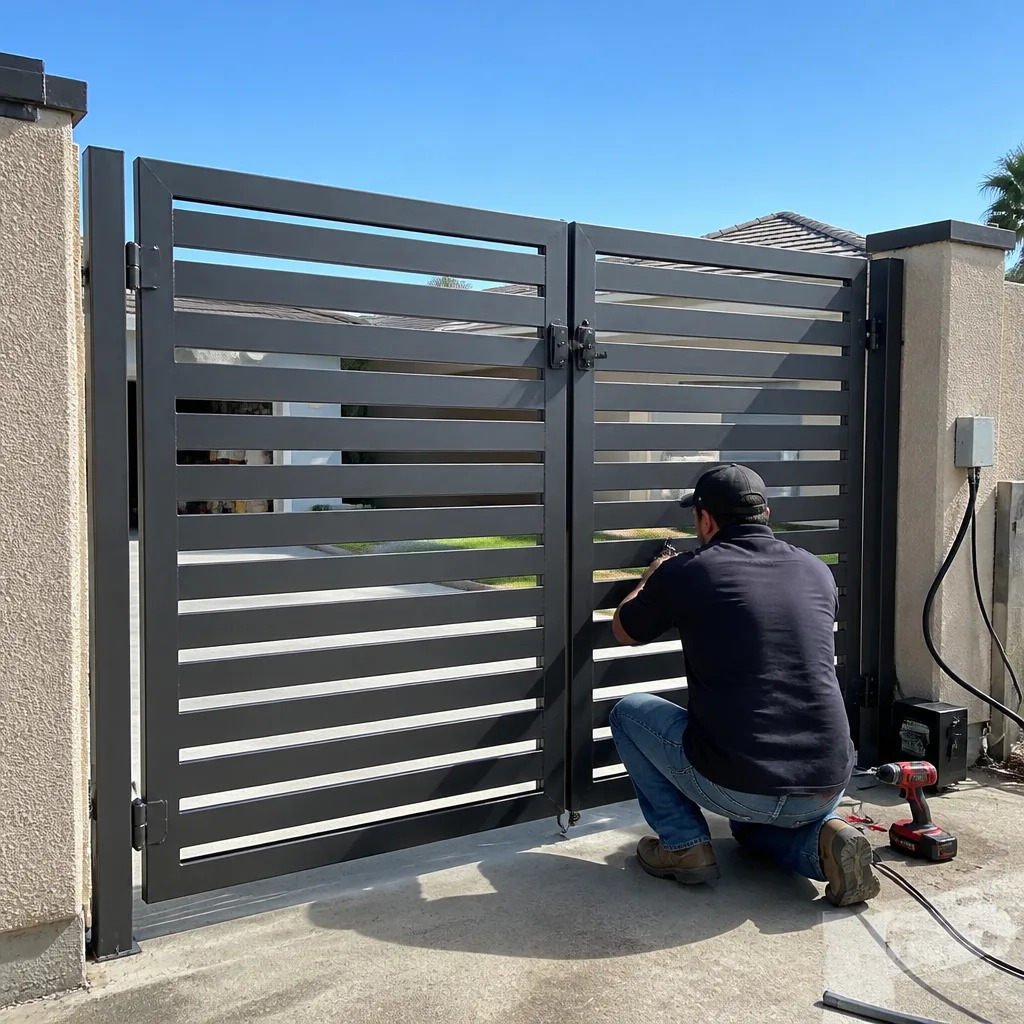 After
After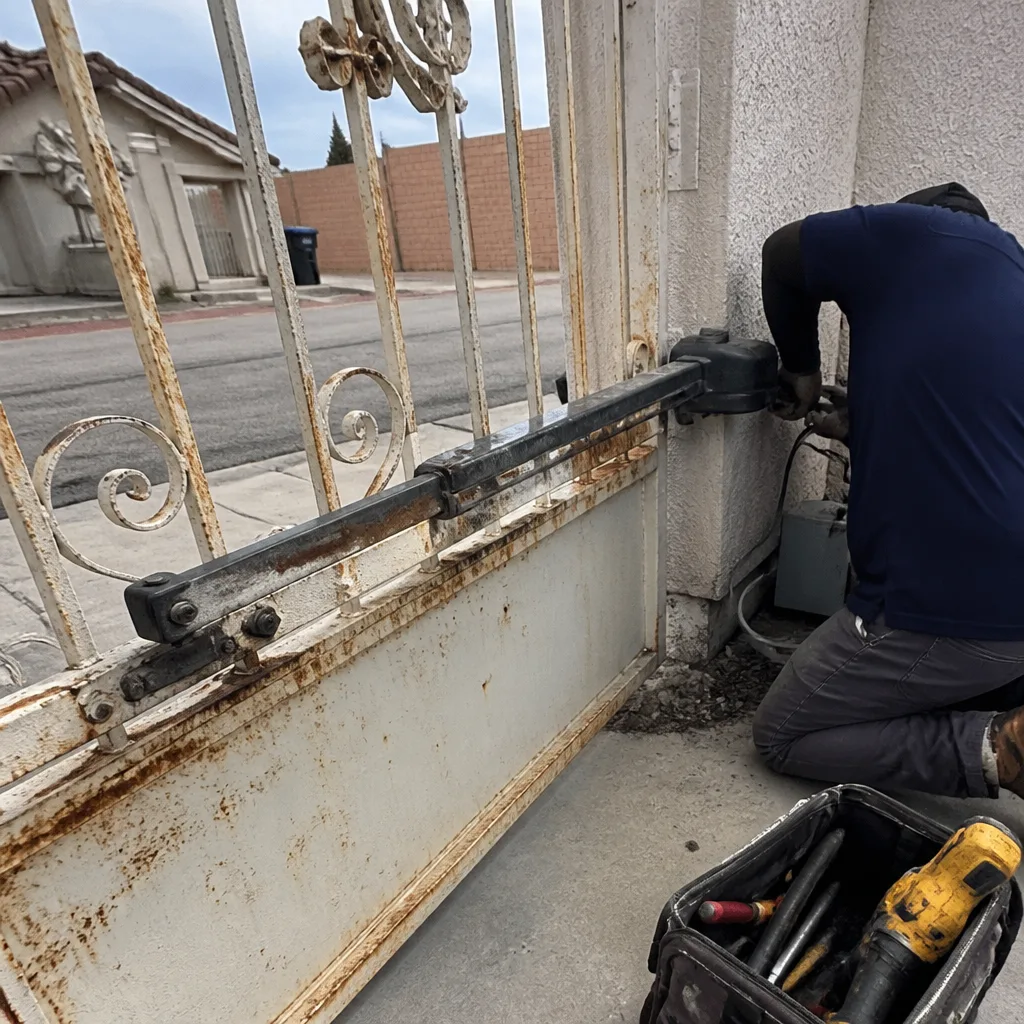 Before
 After
After